Here are the best free VU Meter VST plugins for Windows and Mac. We have included video demos, feature lists, pros, cons, and plugin ratings.
How we rate VU Meter plugins: We rate each VU Meter plugin based on sound quality, design, performance, features, usability, and compatibility. We rate plugins on a scale of 1 to 100.
Table of Contents
I have spent over 15 years testing and comparing hundreds of free and paid VST plugins, supported by hands-on demos on our YouTube channel, which has 12,000+ subscribers.
Best Free VU Meter VST Plugins
This table compares VU Meter VST plugins by operating system, bit version, format, and rating.
| # | Plugins | Ratings | OS | Formats |
|---|---|---|---|---|
| 1 | Correlometer | Windows Mac | VST, AU, AAX | |
| 2 | mvMeter2 | Windows Mac | VST, VST3, AU, AAX | |
| 3 | Youlean Loudness Meter | Windows Mac | VST2, VST3, AU, AAX | |
| 4 | Track Meter | Windows Mac | VST, VST3, AU, AAX | |
| 5 | dpMeter5 | Windows Mac | VST, VST3, AU, AAX | |
| 6 | LVLMeter | Windows | VST | |
| 7 | VU | Windows Linux | VST | |
| 8 | StereoChannel | Windows | VST | |
| 9 | MonoChannel | Windows | VST | |
| 10 | PreSonus VU Meter | Windows | VST |
Related: Free Mastering VST Plugins
1. Correlometer
OS: Windows Win Mac Mac Bit Version: 32-bit, 64-bit Developer: Voxengo Size: 6.8 MB Rating: 94/100
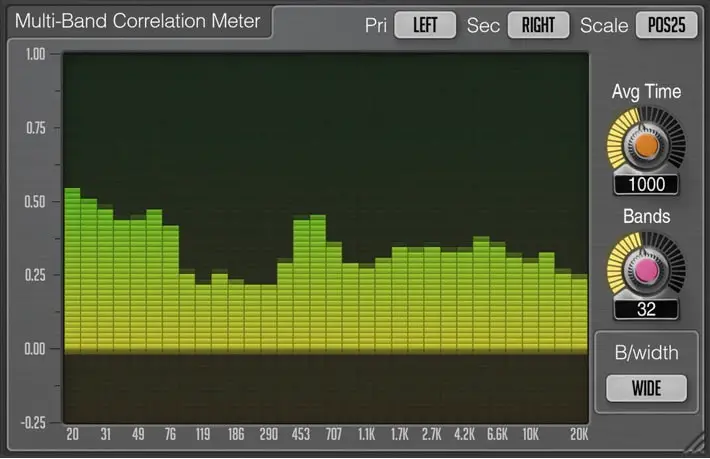
Correlometer is a free analog-style stereo multiband correlation meter for checking phase and mono compatibility across a mix. It shows how closely left and right channels match across the frequency range, helping reveal areas that may lose clarity or cancel when summed to mono.
Choose 4 to 64 bands, adjust band width, quality factor, and averaging time, or use a side-chain input to compare separate tracks. Correlometer has zero latency, peak level tracking, a resizable interface, color schemes, and support for Windows and Mac in VST, AU, and AAX formats.
Features
- Four To 64 Frequency Bands
- Measures Stereo Channel Correlation
- Shows Phase Problems By Frequency
- Adjustable Band Quality Factor
- Adjustable Correlation Averaging Time
- Supports Side-Chain Audio Input
- Tracks Peak Signal Levels
- Frequency Range From 20 Hz
- Resizable User Interface
- Zero Processing Latency
Pros
- Checks phase by frequency
- Supports up to 64 bands
- Shows the full sound range
- Supports side-chain signal checks
- Works with zero added latency
- Uses adjustable averaging time
- Offers adjustable band width
- Lets you choose band quality
- Supports Retina and HD screens
- Includes several color schemes
Cons
- Not a traditional VU meter
- No RMS level readings
- No LUFS loudness measurements
- No true peak readings
- No PPM metering mode
- No EBU R128 display
- No loudness range measurement
Testimonials
Tips
- I place Correlometer on the stereo bus to watch the whole mix. It helps me find phase problems that I may not hear right away.
- I watch the low end first, especially when the bass and kick sound wide. A weak or negative reading may show that these sounds are fighting each other.
- I use the meter while checking a mix in mono. If the sound gets thin or quiet in mono, I look for bands with low correlation.
- Use a peak meter along with a VU meter. The peak meter can warn about short loud hits that a VU meter may not show clearly.
- Keep the meter scale in mind when reading a VU plug-in. Different plug-ins may use different calibration settings, so the numbers are not always directly alike.
- Watch for a steady negative correlation reading in a stereo track. This can point to reversed polarity, timing differences, or wide effects that may disappear in mono.
- Do not chase a perfect meter reading all the time. I listen first, then use the meter to help me find the cause of a problem.
2. mvMeter2
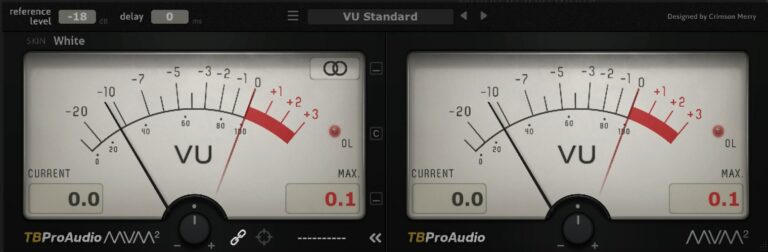
OS: Windows Win Mac Mac Bit Version: 32-bit, 64-bit Developer: TBProAudio Size: 6.8 MB Rating: 85/100
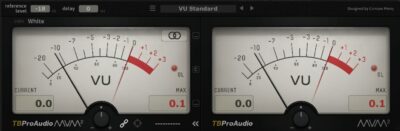
mvMeter2 offers precise audio level monitoring with RMS, EBU R128, VU, and PPM meter modes. It recreates the look and feel of analog meters while supporting stereo, mid, and side channels. Users can view single or dual displays and adjust reference levels for accurate readings.
This plugin helps producers and engineers manage loudness across tracks when mixing or mastering. With preset options, gain trimming, and live meter accuracy, mvMeter2 provides clear visual feedback for consistent volume control. It’s available for free on Windows and macOS in multiple plugin formats.
Features
- Measures RMS, VU, PPM, And EBU
- Supports Stereo And Mid Side Modes
- Adjustable Reference Level Control
- Accurate 64 Bit Internal Processing
- Large Real Time Meter Display
- Scalable Interface Up To 400 Percent
- Five Built In Meter Themes
- Low CPU Usage And Stable Performance
- Works With VST AU And AAX Formats
- Cross Platform Windows And Mac Support
Pros
- Free and full-featured metering tool
- Multiple meter modes in one
- Accurate real-time level tracking
- Lightweight and low CPU usage
- Resizable GUI for any screen
- Supports stereo and mid/side metering
- Adjustable reference level control
- Analog-style VU and PPM look
- Switchable peak and RMS views
- Dual or single meter options
Cons
- No true peak metering option
- Lacks loudness range display
- No built-in spectrum analyzer
- Limited channel routing options
- No waveform visualization feature
- Lacks auto gain correction
- Can feel basic for pros
- GUI scaling sometimes lags
- No color custom settings
- No dark mode option
Testimonials
Tips
- I use the calibration setting to match my expected levels, usually setting 0 VU to -18 dBFS for mixing.
- Place the meter after compressors to see how much gain reduction affects the overall level.
- Use the RMS or VU mode when mixing to get a sense of musical loudness instead of just peaks.
- Monitor both RMS and peak readings together for a better picture of how dynamic your mix is.
- Make sure to calibrate mvMeter2 to match your studio’s reference level for accurate readings.
- Use the stereo mode to ensure balanced loudness between the left and right channels.
- Check the peak mode when mastering to ensure you stay below digital clipping levels.
3. Youlean Loudness Meter
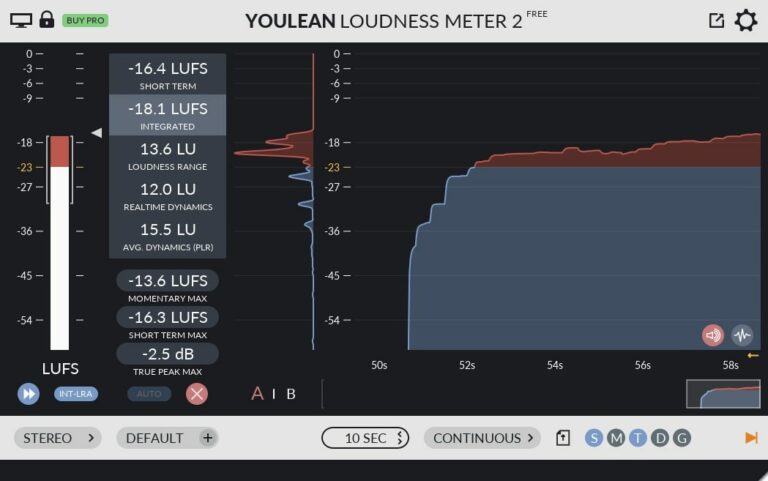
OS: Windows Win Mac Mac Bit Version: 32-bit, 64-bit Developer: Youlean Software Size: 69 MB Rating: 85/100
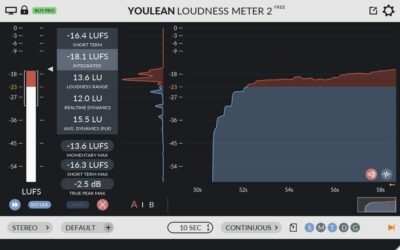
Youlean Loudness Meter offers accurate loudness and dynamics measurement, helping music creators meet broadcast and streaming standards. It supports LUFS, true peak, and loudness range readings across formats like VST, AU, and AAX for Windows and macOS. The plugin provides real-time visual feedback for precise adjustments.
It includes ready-made presets for TV, film, and major streaming platforms like Spotify, YouTube, and Netflix. You can compare mixes, create custom presets, and export reports for clients. With resizable views and clear graphs, it helps your tracks stay balanced and ready for release.
Features
- Measures True Perceived Loudness
- Complies With Industry Loudness Standards
- Includes Streaming Service Presets
- Resizable And Scalable Interface
- Displays Detailed Dynamics Graph
- A/B Comparison Between Measurements
- Accurate Metering With ITU Calibration
- Low CPU Usage Performance
- Readable LUFS, TP, And LRA Display
- Works With Most Major DAWs
Pros
- Accurate loudness and true peak metering
- Supports TV and streaming standards
- Includes film and game presets
- Matches platform standards like Spotify
- Resizable and scalable interface
- Low CPU use during sessions
- Drag and drop audio analysis
- Exports reports as PDF or image
- Supports stereo and surround formats
- Winner of KVR Developer Challenge
Cons
- No built-in frequency analyzer
- No plugin chain integration
- Pro export locked behind paywall
- No integrated spectrum view
- Can be overwhelming for beginners
- No loudness matching automation
- Limited DAW automation support
- No RMS or peak normalization
- Does not show phase correlation
- No built-in calibration tone generator
Testimonials
Tips
- Apply the Youlean Loudness Meter on the master bus to get accurate readings of the final mix.
- Check the LUFS (Loudness Units Full Scale) display to see if the average loudness matches your platform’s needs.
- I use Youlean’s presets to set the right standard, like YouTube or Spotify targets.
- Always keep an eye on True Peak levels to prevent distortion during mastering.
- Use the integrated loudness reading to monitor the whole track’s loudness instead of only short parts.
- Use reference tracks inside your DAW to compare their LUFS and True Peak values with yours.
4. Track Meter
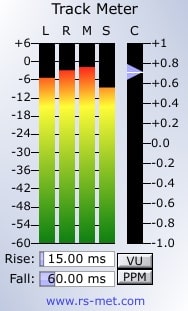
OS: Windows Win Mac Mac Bit Version: 32-bit, 64-bit Developer: DMGAudio Size: 3.4 MB Rating: 82/100
Track Meter offers a complete set of tools for real-time audio monitoring and visual analysis. It displays sound frequencies through detailed 2D and 3D spectrographs, oscilloscopes, and phase meters. Each graph responds smoothly to changes, helping you see and understand every detail of your mix.
It supports loudness standards like ITU1770 and EBU R128, making it useful for mixing, mastering, and broadcast work. With flexible routing, chromatic tuning, and customizable views, Track Meter helps creators compare signals, check balance, and make precise sound decisions across any project.
Features
- Real-Time Audio Frequency Display
- Fully Featured FFT Spectrum Analyzer
- Lissajous And Oscilloscope Displays
- Phase Meter And Correlation Meter
- Chromatic Tuner And Pitch Detector
- Supports Multiple Loudness Standards
- Freely Resizable And Scalable Interface
- Full-Screen Mode With PNG Screenshots
- Multi-Channel Monitoring Up To 7.1
- Light CPU Usage With Fast Response
Pros
- Very clear and bright visuals
- Has both 2D and 3D views
- Supports surround sounds up to 7.1
- Includes clear phase and meter tools
- Strong tuner for pitch checking
- Lets you save picture snapshots
- Very flexible for sound routing
- Super clean and readable layout
- Works great on Mac Retina
- Free and full of strong tools
Cons
- Interface may overwhelm new users
- Limited free version features
- High CPU usage on older PCs
- No sidechain input support
- Lacks plugin delay compensation
- Requires manual routing setup
- No MIDI control or automation
- Slower loading in large projects
- Not ideal for small screens
- Does not support Linux OS
Testimonials
Tips
- I check the peak meter to make sure I’m not clipping any sounds.
- I watch the stereo scope so I can tell if my sound is too wide or too narrow.
- I use the correlation meter to make sure my mix won’t lose anything when played in mono.
- Using both an oscilloscope and a level meter can reveal hidden distortion problems.
- Track Meter helps keep consistent gain staging across all tracks.
- Regularly checking with the plugin helps build good mixing habits over time.
5. dpMeter5
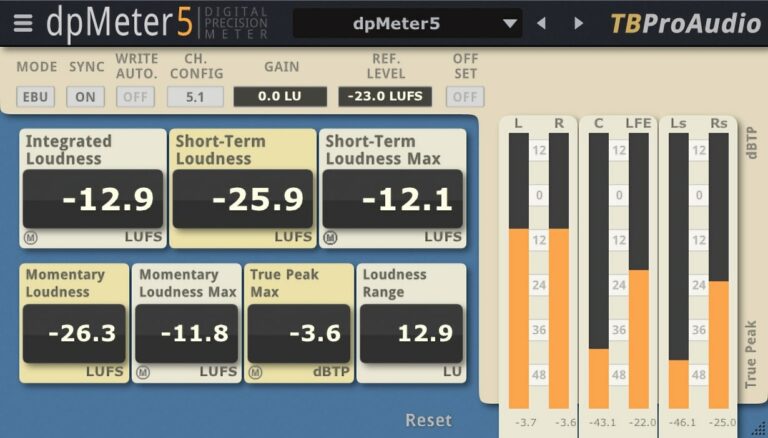
OS: Windows Win Mac Mac Bit Version: 32-bit, 64-bit Developer: TBProAudio Size: 4.9 MB Rating: 82/100
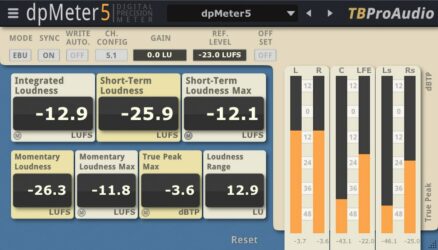
dpMeter5 is a detailed digital audio meter that gives clear readings of volume and loudness levels across multiple channels. It supports RMS, EBU R128, Dialog gated, and TruePeak metering, helping creators keep their mixes consistent and within modern loudness standards.
The plugin works with setups from simple stereo to full 5.1 surround. It includes features like adjustable pre-gain, automation recording, and preset management. Its resizable interface and accurate real-time meters make it a practical choice for mixing, mastering, or broadcast work.
Features
- Accurate Multi Channel Metering
- Supports Up To 5.1 Surround
- Measures RMS And True Peak
- Includes EBU R128 Loudness Mode
- Dialog Gated Measurement Option
- Records Metering As Automation Data
- Resizable And Scalable Interface
- Preset Management System
- Real-Time Large Level Meters
- True Peak Follows ITU BS.1770-4
Pros
- Free and packed with pro features
- Very accurate loudness readings
- Supports many loudness standards
- Works with stereo and surround
- Records metering data as automation
- Accurate LUFS for streaming needs
- Includes true peak measurement
- Customizable scale and color view
- Resizable and clean interface design
- Matches results with paid meters
Cons
- No built-in spectrum analyzer
- Lacks visual loudness history
- No support for LUFS target presets
- Cannot compare two tracks side-by-side
- No integrated input/output gain match
- Does not show phase correlation
- No mid/side metering option
- Lacks fully automated calibration
- GUI looks dated
- Cannot export measurement reports
Testimonials
Tips
- I like to place dpMeter5 at the end of my mix chain to see the true output level of the whole track.
- I use the LUFS readout to make sure my mix is not too loud or too quiet for streaming platforms.
- I check the correlation meter to make sure my mix is not out of phase.
- Placing dpMeter5 on the master bus helps monitor loudness and keep consistent output.
- dpMeter5 can display both peak and RMS values, giving a fuller picture of loudness.
- Using dpMeter5 with a limiter plugin helps control loudness and prevent clipping.
- Setting target LUFS values helps maintain consistent volume across different projects.
6. LVLMeter
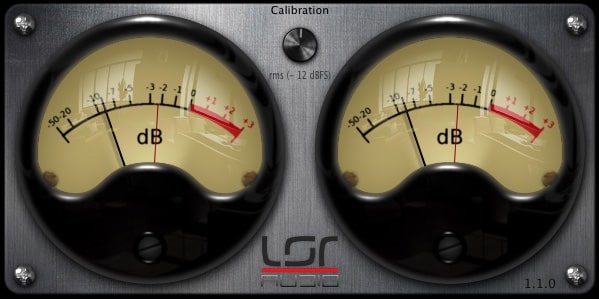
OS: Windows Win Bit Version: 32-bit Developer: LSR Audio Size: 2.3 MB Rating: 72/100
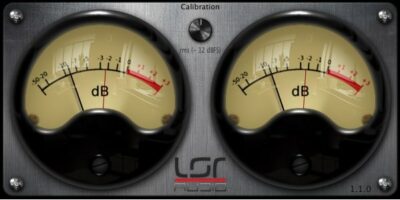
LVLMeter offers a classic VU-style way to check your audio levels while mixing or mastering. It shows stereo loudness using smooth analog-style needles and lets you adjust calibration from -24 dBFS to 0 dBFS. The plugin works in VST, AU, and RTAS formats on Mac and Windows.
It includes peak markers for spotting quick level jumps and supports both 32-bit and 64-bit setups. LVLMeter helps you balance tracks and control headroom with accuracy. Its simple layout makes it a dependable tool for checking loudness across your projects.
Features
- Stereo VU Meter Display
- Vintage Style Needle Meters
- 0dB VU Calibration Control
- Includes Peak Level Marker
- Accurate Level Monitoring Tool
- Low CPU Usage Performance
- Simple And Clear Interface
- Works On Mac And Windows
- Supports VST, AU, And RTAS
- Free Download Plugin
Pros
- Vintage look with real feel
- Very low CPU use
- Smooth and fast needle motion
- Adjustable calibration for accuracy
- Shows both peak and RMS
- Helpful peak marker feature
- Better accuracy than many free meters
- Works in 32-bit and 64-bit
- Very stable with most DAWs
- Great tool for mastering checks
Cons
- No resizable or scalable GUI
- Lacks multi-channel metering support
- No LUFS or loudness metering
- No spectrum or frequency display
- No built-in correlation meter
- No integrated phase meter
- Lacks true peak metering mode
- No sidechain or input selection
- Outdated interface compared to rivals
- No plugin resizing for high DPI
Testimonials
Tips
- I like to start by placing the LVLMeter on my master bus so I can watch the overall loudness of my mix.
- I always compare my LVLMeter readings before and after inserting compressors to make sure I’m not just making things louder.
- I try to keep my levels around 0 VU for a well-balanced mix and enough headroom.
- I find it helpful to switch between peak and RMS modes to see both short bursts and average loudness.
- I like to calibrate the LVLMeter to match my DAW’s reference level, so my readings make more sense.
- I use the meter to spot any parts of the song that are too quiet or too loud.
- Regularly checking the LVLMeter ensures headroom is safe for mastering.
7. VU
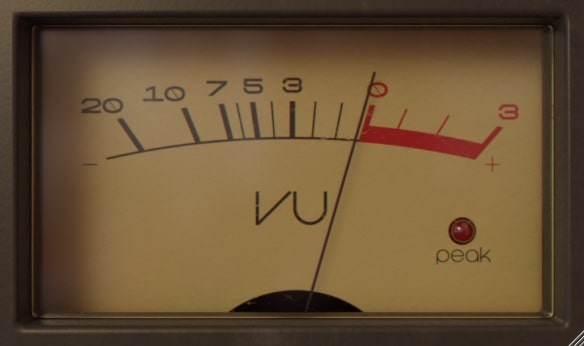
OS: Windows Win Linux Linux Bit Version: 32-bit, 64-bit Developer: UnplugRed Size: 7 MB Rating: 71/100
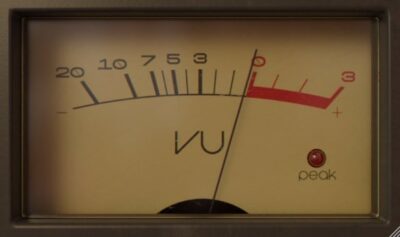
VU is a free VU meter by UnplugRed for Windows and Linux. It offers mono and stereo modes, true RMS metering, RMS display, and a scalable interface for high-resolution screens.
Adjust the reaction speed and nominal operating level to match your setup. A moving needle shows signal strength, while the peak LED warns of very loud levels that may cause clipping.
Features
- Stereo And Mono Modes
- Scalable Vector-Based Interface
- True RMS Level Metering
- Adjustable Meter Reaction Speed
- Adjustable Nominal Operation Level
- Peak Level Warning Light
- Smooth Moving Needle Display
- Classic Analog Meter Design
- Signal Level Scale Display
Pros
- Works on Windows and Linux
- Supports both 32-bit and 64-bit
- Offers stereo and mono modes
- Preserves stereo channel information
- Uses true RMS metering
- Adjusts to different reaction speeds
- Sets the nominal operating level
- Includes a helpful peak LED
- Shows levels with a moving needle
- Scales cleanly on large screens
Cons
- Windows and Linux only
- VST format only
- No VST3 support like fMeter
- No macOS version
- Reported black window problems
- No LUFS loudness measurement like Youlean
- No true-peak meter
Testimonials
Tips
- I place VU by UnplugRed on a track or bus to watch its average loudness while I mix. It helps me see level changes that my ears may miss.
- I adjust the nominal operating level, or NoL, to match the plugin or hardware I am using. A good setting makes the meter easier to read and more useful.
- I keep an eye on the peak light when I raise the volume. If it flashes often, I lower the level and check for clipping.
- I compare the meter before and after a plugin when I am gain matching. Matching the volume helps me judge the sound instead of simply choosing the louder option.
- Use the reaction speed control to match the job. Faster settings show quick changes, while slower settings make the overall level easier to follow.
- Remember that a VU meter shows average loudness more clearly than very short peaks. Use a peak meter too when you need to find clipping.
8. StereoChannel
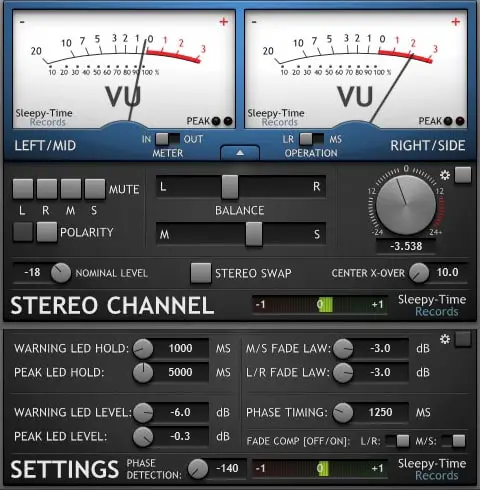
OS: Windows Win Bit Version: 32-bit, 64-bit Developer: Sleepy-Time DSP Size: 1 MB Rating: 70/100
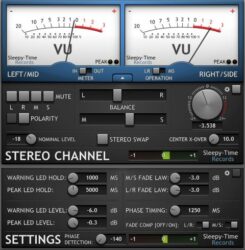
StereoChannel is a Windows VST plugin that combines a stereo tool with a classic VU meter. It displays left/right or mid/side levels and includes gain control, balance adjustment, polarity switching, stereo swapping, and phase correlation monitoring.
Its center crossover, phase timing, fade compensation, and adjustable warning and peak LEDs support detailed signal checks. Choose input or output metering, set nominal levels, mute channels, and control stereo output gain across a ±24 dB range.
Features
- Stereo Tool And VU Meter
- L/R And M/S Balance Control
- Classic VU Meter Display
- Plus Or Minus 24 dB Gain
- Stereo Phase Correlation Meter
- Channel Polarity Switching
- Left And Right Channel Swap
- Adjustable Phase Timing
- Left, Right, Mid, Side Muting
- Input And Output Metering
Pros
- Mid and side metering
- Flexible L/R balance control
- Useful M/S balance control
- Wide ±24 dB gain range
- Built-in phase correlation meter
- Quick polarity switching
- Instant stereo channel swapping
- Center crossover control included
- Fade compensation keeps levels steady
Cons
- Windows users only
- Limited plugin format support
- No LUFS loudness readings
- No true peak readings
- No RMS measurement mode
- No offline file analysis
- Development appears discontinued
Testimonials
Tips
- I set the Nominal Level knob to match my audio interface or converter. This gives the VU meter a useful 0 VU target.
- I use the gain control to set a healthy level before other plugins. StereoChannel offers up to 24 dB of gain in either direction.
- A VU meter shows average loudness more than short peaks, so it should be used with a peak meter when clipping is a concern.
- Keep the VU meter at the end of a plugin chain to check the level after all processing.
- Check a mix in mono after watching the phase meter. Stereo sounds can lose power when the left and right channels are combined.
- Place a VU meter before a compressor to see the level going in, and place another after it to see the level coming out.
- Listen while watching the meters instead of mixing by sight alone. The meters are guides, but the final choice should come from the sound.
9. MonoChannel
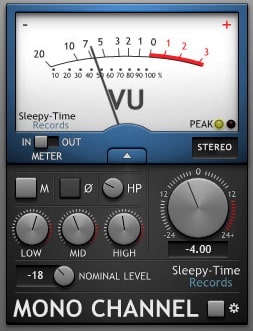
OS: Windows Win Bit Version: 32-bit, 64-bit Developer: Sleepy-Time DSP Size: 1 MB Rating: 61/100
MonoChannel is a free Windows VST plugin that combines a moving-needle VU meter with basic mono channel controls. It includes gain, input and output metering, peak lights, mute, stereo mode, phase inversion, and nominal level adjustment for gain staging.
Its smooth high-pass filter and three-band EQ shape bass, midrange, and treble, while output control helps set final levels. Available in 32-bit and 64-bit formats, MonoChannel suits creators who want simple console-style metering and tone control.
Features
- Classic Moving-Needle VU Meter
- Input And Output Metering
- Adjustable Gain Control
- Smooth High-Pass Filter
- Three-Band Tone-Shaping EQ
- Nominal Level Adjustment
- Peak Level Indicator
- Stereo Operation Mode
- Phase Inversion Button
- Mono-Channel Processing
Pros
- Classic moving needle VU meter
- Adds EQ beside metering
- Smooth high-pass filter control
- Three-band tone shaping onboard
- Wide 24 dB gain range
- Input and output level views
- Helpful peak warning lights
- Includes stereo monitoring mode
- Adjustable nominal level setting
Cons
- Windows-only support limits wider use
- VST format leaves out VST3
- No AU or AAX versions
- Mono operation limits stereo work
- No LUFS loudness readings
- No true peak measurements
- No loudness range tracking
Testimonials
Tips
- I use the input meter to see the level before making changes. Then I use the output meter to check the level after EQ or gain changes.
- I adjust the gain knob slowly instead of making a large change at once. MonoChannel offers up to 24 dB of gain in either direction.
- I use the high-pass filter to remove deep rumble from vocals, guitars, and other tracks. I turn it up only as far as needed so the sound stays full.
- I use the low, mid, and high controls for small tone changes. Small EQ moves often sound more natural than large boosts.
- I check the VU meter while a song section is playing, not just during silence. This helps me see the level during the loud parts.
- I compare the sound before and after each change. I use the meter and my ears together instead of trusting only one of them.
- Use the peak meter in the DAW along with the VU meter. A VU meter shows average level, while a peak meter helps catch short loud spikes.
10. PreSonus VU Meter

OS: Windows Win Bit Version: 64-bit Developer: PreSonus Audio Electronics Size: 5 MB Rating: 60/100
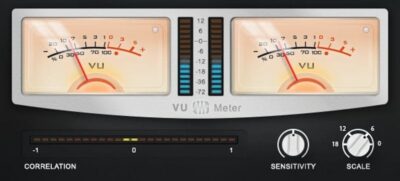
PreSonus VU Meter is a free metering plug-in for Mac and Windows that combines analog-style VU needles, LED-style peak bars, and clip indicators. It displays left, right, and master levels to help music creators monitor average volume and peaks.
A stereo correlation meter shows the phase relationship between channels, with readings from -1 to +1. Adjustable sensitivity and level scaling from 0 to -18 dB support gain staging and mastering. It works with VST3, AudioUnit, and AAX hosts.
Features
- Analog-Style VU Metering
- LED Peak Level Metering
- Stereo Correlation Meter
- Adjustable Meter Sensitivity
- Switchable Level Scaling
- Dual Channel Meters
- Master Output Level Display
- Clip Indicators For Loud Levels
- Mono And Stereo Meter Modes
- VST3, AudioUnit, And AAX Support
Pros
- Free standalone metering tool
- Combines VU and peak meters
- Adds stereo correlation feedback
- Adjustable meter sensitivity control
- Selectable scale ranges
- Includes dual analog-style meters
- Includes center bar meters
- Supports mono and stereo signals
- Works with VST3, AU, AAX
- Built from channel strip components
Cons
- No LUFS loudness readings
- No true-peak measurement
- No RMS metering mode
- No PPM metering mode
- No Mid-Side metering option
- No mono-sum safety check
- No spectrum analysis view
Testimonials
Tips
- I place the PreSonus VU Meter first on a track to check the level coming into my effects.
- I aim for about -18 dB average level when I set up a digital track. This gives many plugins a clean signal to work with.
- I compare the level with a plugin on and off. I try to keep both levels close so louder does not sound “better” by mistake.
- I watch the meter during the loudest part of the song, not just during a quiet verse.
- A VU meter shows average loudness over time, so it will not react as quickly as a peak meter.
- Use a peak meter too, because short digital peaks can pass by a VU meter.
- I use my ears along with the meter because a good meter reading does not always mean the mix sounds good.
VU Meter VST Plugins Compared
This table compares VU Meter VST plugins by features, controls, effects, formats, and more.
| Details | Correlometer | mvMeter2 | Youlean Loudness Meter | Track Meter | dpMeter5 | LVLMeter | VU | StereoChannel | MonoChannel | PreSonus VU Meter |
|---|---|---|---|---|---|---|---|---|---|---|
| Image |  |
 |
 |
 |
 |
 |
 |
 |
 |
 |
| Rating | ||||||||||
| OS | Windows, Mac | Windows, Mac | Windows, Mac | Windows, Mac | Windows, Mac | Windows | Windows, Linux | Windows | Windows | Windows |
| Formats | VST, AU, AAX | VST, VST3, AU, AAX | VST2, VST3, AU, AAX | VST, VST3, AU, AAX | VST, VST3, AU, AAX | VST | VST | VST | VST | VST |
| Bit Version | 32-bit, 64-bit | 32-bit, 64-bit | 32-bit, 64-bit | 32-bit, 64-bit | 32-bit, 64-bit | 32-bit | 32-bit, 64-bit | 32-bit, 64-bit | 32-bit, 64-bit | 64-bit |
| Developer | Voxengo | TBProAudio | Youlean Software | DMGAudio | TBProAudio | LSR Audio | UnplugRed | Sleepy-Time DSP | Sleepy-Time DSP | PreSonus Audio Electronics |
| License | Freeware | Freeware | Freeware | Freeware | Freeware | Commercial | GPL | Freeware | Freeware | Freeware |
| Sample-Based | No | No | No | No | No | No | No | No | No | No |
| Download Size | 6.8 MB | 6.8 MB | 69 MB | 3.4 MB | 4.9 MB | 2.3 MB | 7 MB | 1 MB | 1 MB | 5 MB |
| CPU Load | Low | Low | Low | Low | Low | Low | Low | Low | Low | Low |
| Polyphony | N/A | 2 | N/A | 2 | 2 | 2 | N/A | N/A | N/A | N/A |
| Features | Multiband Correlation Meter, Adjustable Band Count, Adjustable Band Quality, Adjustable Averaging Time, Sidechain Input, Phase Alignment, Peak Level Tracking | Analog behavior, Multiple metering modes, Dual display, Adjustable reference level, Meter delay, Preset management, GUI scaling | Accurate metering, Loudness measurement, Dynamics analysis, Streaming presets, Custom presets, A/B comparison, Export options | FFT Spectrum Analyzer, 2D/3D Spectrographs, Phase/Correlation Meter, Chromatic Tuner, Loudness Metering, Multi-Spectrum Comparison, Freely-Resizable UI | RMS metering, EBU R128, Dialog gated, TruePeak measurement, Adjustable pre-gain, Preset management, GUI scaling | Stereo metering, Vintage design, VU calibration, Peak marker, RMS support, K-metering, Free plugin | Stereo/Mono Modes, Scalable UI, True RMS Metering, Adjustable Reaction Speed, Nominal Level Adjustment, Peak LED, Analog Display | Stereo Tool, VU Meter, L/R & M/S Balance, Gain Control, Phase Correlation, Center Crossover, Polarity Switch | Classic VU Meter, Gain Control, High-Pass Filter, Three-Band EQ, Input/Output Metering, Phase Inversion, Mute Function | Analog VU Meter, Peak Metering, Correlation Meter, Variable Sensitivity, Level Scaling, Dual Meters, Clip Indicators |
| Controls | Band Count, Band Quality, Average Time, Side-Chain Input, Primary Channel, Secondary Channel, Color Scheme | Reference Level, Delay, VU Standard Menu, Skin Selector, Linked/Unlinked Button, Central Knob, VU Meters | Loudness Meters, LUFS Display, Dynamics Graph, Preset Menu, A/B Comparison, View Buttons, Export Options | 3D Spectrograph Display, dB Scale, Frequency Numbers, Color Spectrum, Left/Right Channel Indicator, Toolbar, Snapshot Feature | Mode, Sync, Write Auto, Ch. Config, Gain, Ref Level, Reset | Calibration Knob, Left VU Meter, Right VU Meter, Needles, Scale Markings, LSR Audio Logo, Version Number | Stereo/Mono Mode, UI Scaling, Reaction Speed, Nominal Operating Level, Peak LED, RMS Mode, VU Meter | Gain Control, Balance Control, Center Crossover, VU Meter, Phase Meter, Polarity Switch, Stereo Swap | VU Meter, Meter Switch, Peak Indicator, Stereo Button, Mute Button, Phase Button, High-Pass Filter | Left VU Meter, Right VU Meter, Peak Level Meters, Correlation Meter, Sensitivity Knob, Scale Knob, Master Output Level |
| Effects Included | None | Unknown | Unknown | Unknown | Unknown | Unknown | Unknown | Gain control, L/R and M/S balance adjustment, center crossover, polarity inversion, stereo swap, muting | High-pass filter, three-band EQ | None |
| MIDI Learn | No | No | Unknown | Unknown | No | Unknown | No | No | No | No |
| Presets | 1 | N/A | N/A | N/A | N/A | N/A | N/A | N/A | N/A | 4 |
| Standalone | No | No | Yes | No | No | Yes | Yes | No | No | Yes |
| Last Updated | 03/06/2025 | 08/26/2023 | 06/12/2024 | 08/28/2023 | 07/14/2024 | 01/09/2017 | 11/01/2026 | 08/15/2012 | 08/05/2012 | N/A |
Favorite VU Meter VST Plugin
Our top pick for the best free VU Meter VST plugin is Youlean Loudness Meter by Youlean Software. It offers a clean interface, helpful features, and it available for Windows and Mac.
| Details | Youlean Loudness Meter |
|---|---|
| Image |
|
| Rating | |
| OS | Windows, Mac |
| Formats | VST2, VST3, AU, AAX |
| Bit Version | 32-bit, 64-bit |
| Developer | Youlean Software |
| License | Freeware |
| Sample-Based | No |
| Download Size | 69 MB |
| CPU Load | Low |
| Polyphony | N/A |
| Features | Accurate metering, Loudness measurement, Dynamics analysis, Streaming presets, Custom presets, A/B comparison, Export options |
| Controls | Loudness Meters, LUFS Display, Dynamics Graph, Preset Menu, A/B Comparison, View Buttons, Export Options |
| Effects Included | Unknown |
| Download | Download Youlean Loudness Meter |
VU Meter VST FAQs
How to Install VU Meter VST Plugins
To install VU Meter VST plugins on Windows or Mac, extract the files from the Zip or Rar. Move the files (.dll for Windows or .component for Mac) into your DAW’s plugin folder. Then restart your software and rescan the directory to complete the process. Tutorial: How to Install VST Plugins
Windows:
Extract the downloaded zip file and copy the .dll file into the VST plugins folder scanned by your DAW. Restart your music software and rescan your plugin directory to begin using the new VST.
Mac OS X:
Extract the downloaded archive and move the .component or .VST file to the plugin folder. It is usually /Library/Audio/Plug-Ins/Components or /Library/Audio/Plug-Ins/VST. Restart your DAW and rescan your plugins to complete the installation.
What Is A VU Meter Plugin?
A VU meter plugin is software that emulates Volume Unit meters. These plugins monitor the level of an audio signal and can help you ensure that your audio is at the correct level.
Each plugin on this list has unique features and capabilities, so be sure to read through the descriptions to determine which is best for your needs.
They are often used in the film and TV industry to comply with strict loudness requirements. They are also used to monitor the stereo image and ensure that it is balanced. These VU Meters can be used with many popular DAWs, such as FL Studio, Ableton Live, Logic Pro, and more.
What Does VU Mean?
The Term VU stands for Volume Units, which is a term that was initially used with radio broadcast equipment. It is a measurement of the strength or power of a sound signal. VU meters indicate when a sound is too loud or too quiet for a particular application.
What Are VU Meters?
VU meters are devices used to measure the level of an audio signal. They were initially created for use in radio broadcasting, but they are now used in various applications, including the film and TV industries.
They typically have ballistics or response curves that emulate the vintage VU meters. This allows you to monitor the audio signal similarly to how the human ear perceives sound.
Why Use A VU Meter Plugin?
VU meter plugins can be beneficial to ensure that your audio is within a specific level. They can also help you monitor the stereo image and ensure it is balanced. Additionally, they can be used to comply with loudness requirements.
How Do I Use A VU Meter Plugin?
Each VU meter plugin will have its own unique interface, so there is no one-size-fits-all answer to this question. However, most VU meter plugins will allow you to monitor the level of an audio signal in real time. This will enable you to make adjustments to your audio as needed.
Additionally, many VU meter plugins will include features that allow you to save or record the metering results. This can be helpful for further analysis.
Benefits Of Using VU Meter Plugins
VU meter plugins can be beneficial to ensure that your audio is within a specific level. They can also help you monitor the stereo image and balance it.
Additionally, they can be used to comply with loudness requirements for broadcast media or streaming services such as YouTube or Spotify, which have guidelines for acceptable levels of loudness.
They are not to be flagged as too loud by their automated systems. Finally, using one of these plugins ensures that any noticeable fluctuations in sound will not occur during playback. This could lead to listening fatigue or even damage to speakers if too much power passes through them simultaneously due to excessive volume levels.
These free VU meters are great alternatives to paid plugins like the Waves VU Meter plugin.
I hope you found this list of free VU meter plugins helpful.